
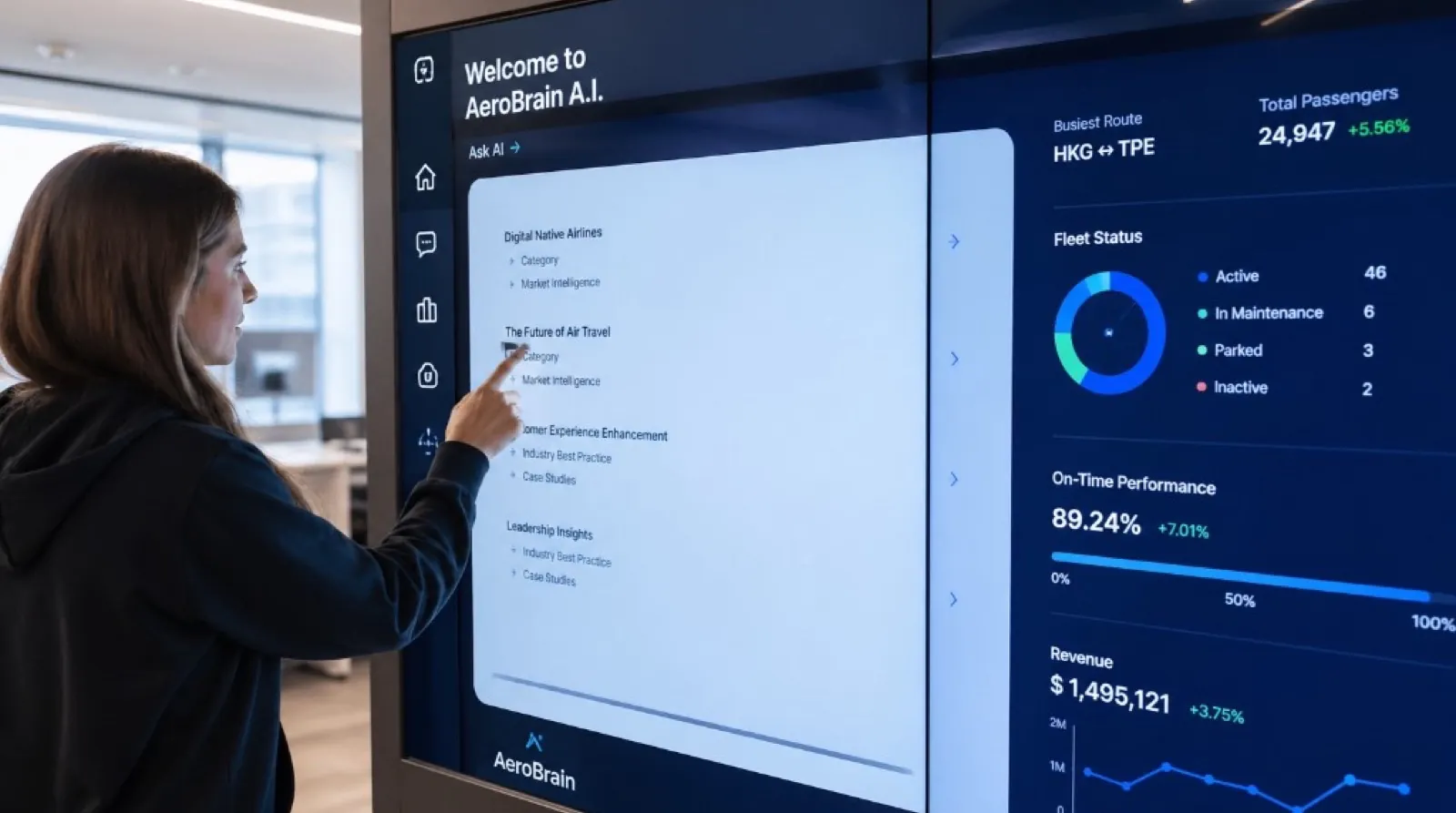
OpsEye · AI operations control, powered by AeroBrain
OpsEye: one brain runs your airline's operations.
See every flight. Predict the disruption. Resolve it by your rules. Watch it get done.
OpsEye is the operations control system built on AeroBrain, the central AI that knows your fleet, crews, maintenance status, slots, weather, NOTAMs and passengers at once. When something breaks, it proposes ranked, costed recovery plans shaped by your company policy and your KPIs, notifies every department in its own app, and tracks each action until the recovery is complete. Real-time optimisation for digital-native airlines, with savings you can measure from the first month.
- One brain
- Fleet, crew, maintenance, slots and passengers in one model
- Seconds
- Ranked recovery options while the disruption unfolds
- Your rules
- Plans weighted by your policy and your KPIs
- Month one
- Every decision costed against the counterfactual from day one
Disruption isn't the expensive part. The phone calls are.
A hydraulic snag becomes an AOG, the crew runs out of duty time, the slot is lost and two hundred passengers miss connections, while ops, crew control, maintenance and the customer desk piece it together over phone and chat. Every minute of that is cost you cannot see and cannot prove.
The backbone
AeroBrain: the central brain of your airline.
Under OpsEye sits AeroBrain, the AI that holds the whole operation in one model: schedule, aircraft, crew legality, MEL items, slots, weather, NOTAMs, passengers and cost. It knows your company policy and the KPIs you run the airline by, so when something goes wrong it doesn't hand you a data dump: it hands you structured, ranked solutions for the disruption, the fuel, the crew and the passengers, each with its reasoning.
- One model of the operation instead of a dozen systems that disagree
- Configured to your company policy, escalation rules and KPIs, not a vendor default
- Structured proposals: disruption recovery, fuel and Cost Index, crew, passenger re-protection
- Every proposal explains itself; a person always makes the call
- The same AeroBrain engine that powers SkyDynamics training and defence products
Inside the OCC
Complex underneath. Simple to operate.
The system does the heavy lifting; controllers see a clean board, a clear priority and the next action. Five of the views your operations control centre works in every day.
Fleet board
Every aircraft on one board: status, origin and destination delay trends, the disruption index at each station and any open irregularity: AOG rows impossible to miss.
Step 1 of 5
Live network
ADS-B and ACARS positions on the map, a flight tracker beside it, and each station's disruption index so you see where the network is under strain.
Step 2 of 5
ATFM & slots
Active regulations, a CTOT countdown for every affected flight and ready messages (REA) sent automatically where your rules allow, with a predictive alert before the flow restriction lands.
Step 3 of 5
Crew & maintenance
Crew rosters with FTL headroom and licence status next to the MEL board (CAT A to D, deferrals and AOG) so a recovery plan never assigns an illegal crew or an unfit aircraft.
Step 4 of 5
Passenger recovery
Unaccompanied minors, medical cases and reduced-mobility passengers handled first, SLA tiers for everyone else, and EC261 care and compensation handled inside the recovery flow.
Step 5 of 5
Predictive disruption
See the disruption hours before it happens.
OpsEye scores every flight in the next hours with a disruption index built from live weather trends, NOTAMs, crew duty time, MEL deadlines, network cascade and airport capacity, and shows which factor is driving it. The crew gets a plain-language NOTAM briefing for their route. You act while it's still cheap.
- Weather (METAR / TAF trend), NOTAMs, crew FDP, MEL deadlines, network cascade, airport capacity
- A per-flight index with the reasons behind it, not a black-box score
- Captain's NOTAM briefing generated for origin, destination and alternate
- Honest about data: if a source is down, OpsEye tells you the prediction is degraded
Disruption resolution engine
Ranked recovery plans, costed and legal.
When a disruption opens, AeroBrain builds the recovery options for you (aircraft swap, crew from standby, delay, cancel and re-protect) and ranks them on risk, time, fuel, crew impact, passenger delay and cost. Each plan is checked against crew FTL, curfews, MEL, minimum connection times and maintenance capability before you see it, and shows its confidence. Regulated actions go through four-eyes approval.
- Plans weighted by what you choose: cost, time or passenger satisfaction
- Hard constraints wired in: crew FTL, curfew, MEL, MCT, maintenance capability
- Decision gate, passengers at risk and cost exposure on every case
- Four-eyes approval on regulated actions; fast commit where your policy allows
Prioritised by you
Your policy decides the order. You can overrule it.
Every irregularity lands in one priority queue (safety first, then legality, hub integrity and cost) using the escalation rules and owners your airline defines. When the situation calls for it, the duty manager can bypass a policy: OpsEye asks for a second approver and records who decided what, and why.
- One queue for every open item, ordered by your escalation rules
- Named owners and escalation times per category
- Cost gates that route large decisions to the right authority
- Policy override with four-eyes approval and a full audit trail
Execution monitor
Commit the plan. Everyone knows. Watch it get done.
The moment a plan is committed, every department involved is notified in its own app with the actions assigned to it. As people acknowledge and complete their tasks, the plan updates itself in real time, so the OCC sees which workstream is done, which is late and what is blocking the recovery, without a single status call.
- Instant notification to maintenance, crew control, customer service, load control and slots
- Each action has an owner, a deadline and Ack / Done / Fail states
- Overdue actions surface automatically; plan health updates live
- The full timeline is kept for debrief, audit and training
The loop
Predict, decide, execute: in one system
Predict
Disruption index per flight from weather, NOTAMs, crew duty, MEL and network data.
Detect
ACARS, AODB, ATFM and tech-log events open a case with decision gate and exposure.
Rank
Recovery plans scored on risk, time, fuel, crew, passengers and cost, by your weights.
Commit
Fast commit for time-critical actions, four-eyes approval for regulated ones.
Execute & track
Every department notified; tasks tracked to completion in real time.
No more communication barriers
A dedicated app for every department. One brain behind them.
Everyone works in an app built for their job, and every app reads from and writes to the same AeroBrain model. The OCC and your integrated control centre see the real state of the operation, not the last phone call.
Ops control
Fleet board, network, ATFM, disruption engine and execution monitor for the OCC.
Crew control
Rosters, pairings, FTL compliance, licences and disruption assignments.
Crew app
Duty changes, reporting times and briefings pushed to the crew, acknowledged in the app.
Maintenance
MEL board, AOG protocol and tech log feeding aircraft status straight into recovery.
Load control
Load and balance aligned with the swap, fuel and passenger changes the plan makes.
Sales & passengers
Re-protection, special handling and EC261 in step with what operations decided.
Integrated control centre
Real-time visibility for the ICC and leadership: cases, exposure and progress, live.
Cost reduction from month one
Savings you can prove, from the first month.
Real-time optimisation of fuel, time, aircraft, crew and Cost Index, inside FTL, EU 261, ETS and CORSIA guardrails. Every decision is costed against what would have happened without OpsEye, so from the first month your CFO sees saving per decision in an audit-locked ledger, not a vendor estimate.
- Fuel: tankering, centre of gravity, CO₂
- Time & asset: aircraft, crew and slot cost modelling
- Cost Index governance with FTL / EU 261 / ETS / CORSIA guardrails
- Counterfactual ROI: baseline minus actual, audit-locked
Built for digital-native airlines
Enterprise depth without enterprise drag
OpsEye is built to go live fast and stay light to run, for airlines that want their operation to be as digital as their booking flow.
Manuals in one query
MEL, AMM, QRH, FCOM and Ops Manual searched together by AeroBrain.
Specialised agents
OCC, crew, maintenance, finance, safety, dispatch and passenger recovery.
Offline by default
Keeps running on the workstation during an outage; syncs on reconnect.
Four-eyes approval
Regulatory-grade dual commit on regulated actions.
Connects to what you run
ACARS, AODB, ADS-B, EUROCONTROL NM B2B and your crew and maintenance systems.
Audit trail
Who proposed, who approved, who executed, kept for every case.
Why OpsEye
Versus a traditional OCC
React after the cascade
predict it hours ahead, with the reasons.
Recovery built by hand
ranked, costed, legal plans in seconds.
Vendor-default logic
your policy, your KPIs, your overrides on record.
Phone and chat coordination
every department notified in its own app.
Status by calling around
execution tracked live, action by action.
Unprovable savings
counterfactual, CFO-ready ROI from month one.
OpsEye: questions buyers ask
What is OpsEye?
OpsEye is SkyDynamics' AI operations control system for airlines. Built on the AeroBrain AI, it monitors the fleet and network in real time, predicts disruptions, proposes ranked and costed recovery plans according to your company policy and KPIs, notifies every department in its own app and tracks the recovery until it is complete.
What role does AeroBrain play?
AeroBrain is the backbone: the central AI that holds fleet, crew, maintenance, slots, weather, NOTAMs, passengers and cost in one model. OpsEye is how the operations control centre works with it. The same AeroBrain engine runs across SkyDynamics operations, training and defence products.
How fast does OpsEye respond to a disruption?
Ranked recovery options are available within seconds of a case opening, covering aircraft, crew, gates and passenger re-protection. A person decides; regulated actions require four-eyes approval.
Can we adapt it to our company policy and KPIs?
Yes. You set the weights (cost, time, passenger satisfaction), the escalation rules, owners and cost gates, and the KPIs plans are measured against. A duty manager can bypass a policy when needed; OpsEye requires a second approver and logs the decision.
What does OpsEye predict?
A disruption index per flight from weather trends (METAR / TAF), NOTAMs, crew flight-duty time, MEL deadlines, network cascade and airport capacity, with the contributing factors shown. It also produces a NOTAM briefing for the crew.
How do departments stay in sync?
Ops control, crew control, the crew app, maintenance, load control, sales and the integrated control centre each have their own app on the same AeroBrain model. When a plan is committed, each department gets its actions; as people acknowledge and complete them, the plan updates in real time.
When do savings show?
From the first month. Every decision is costed against the counterfactual, what would have happened without OpsEye, and kept in an audit-locked ledger, so savings are measured, not estimated.
Does it work during a network outage?
Yes. OpsEye keeps working on the workstation with local storage and syncs when the connection returns.
Which regulations does it respect?
EASA ORO.FTL.205, EU 261, EU ETS, CORSIA, ICAO Doc 4444 and Part-145, with four-eyes approval on regulated actions.
One ecosystem. One central brain.
OpsEye is one node on a connected platform.
See OpsEye resolve a live disruption
Bring a real disruption from your operation. We'll show you the prediction, the ranked plans under your policy, and the execution, end to end.
We respond within one business day.