
R&D
Research
SkyDynamics advances aviation AI through research in human factors, neurophysiological signal analysis, evidence-based training, and operational decision intelligence.
Aviation Research at SkyDynamics
SkyDynamics operates at the intersection of aviation operations, training science, and artificial intelligence. Our research division - rooted in the same academic research the company grew out of - pursues applied and fundamental research that directly improves how pilots train, crews decide, and organisations learn.
Our core research pillars are human factors in aviation, neurophysiological signal analysis for training and operational environments, and AI-assisted decision intelligence. Every research initiative is designed to transition from the laboratory to the flight deck, the simulator, or the operations control centre.
From our R&D facilities in Heraklion, Crete, we collaborate with airlines, training organisations, universities, and defence partners across Europe and the Middle East. Our work is published in peer-reviewed journals and presented at international aviation and human-factors conferences.
Human Factors Research
Understanding the Human in the Loop
SkyDynamics' human factors research investigates how pilots, cabin crew, dispatchers, and maintenance technicians interact with increasingly automated and AI-augmented systems. Our goal is to ensure that technology enhances - rather than erodes - situational awareness, decision quality, and crew resource management.
Cognitive Workload & Attention Modelling
We study cognitive load distribution across flight phases, from pre-flight planning through approach and landing. Using eye-tracking, pupilometry, and reaction-time paradigms, we map attention allocation patterns and identify conditions that lead to attentional tunnelling or workload saturation. These models inform the design of AeroBrain agentic tools - ensuring AI assistance is offered at the right moment, in the right modality, without adding to information overload.
Crew Resource Management & Communication
Our research extends to multi-crew communication dynamics, particularly during non-normal and emergency scenarios. We analyse communication patterns, leadership transitions, and shared-mental-model alignment in full-mission simulator exercises. Findings feed directly into AeroEBT scenario design, creating evidence-based training that targets real crew performance gaps.
Human-AI Teaming
As AI agents like Wingman and OpsEye enter the operational workflow, we research trust calibration, automation surprise, and authority gradient between human operators and AI recommendations. Our human-AI teaming framework ensures that AI remains a transparent, contestable, and supportive partner - not an opaque decision-maker.
Selected Research Areas
- Attention allocation in glass-cockpit vs AI-augmented environments - comparative studies on scan patterns and situation awareness.
- Startle and surprise response - measuring physiological markers during unexpected events in FFS and FNPT II sessions.
- Fatigue and circadian disruption - neurophysiological correlates of fatigue in long-haul and shift-based operations.
- Debriefing effectiveness - how structured debriefing formats impact learning retention and competency development.
Neurophysiological Signals in Training & Operations
Measuring What Matters - From Brainwave to Behaviour
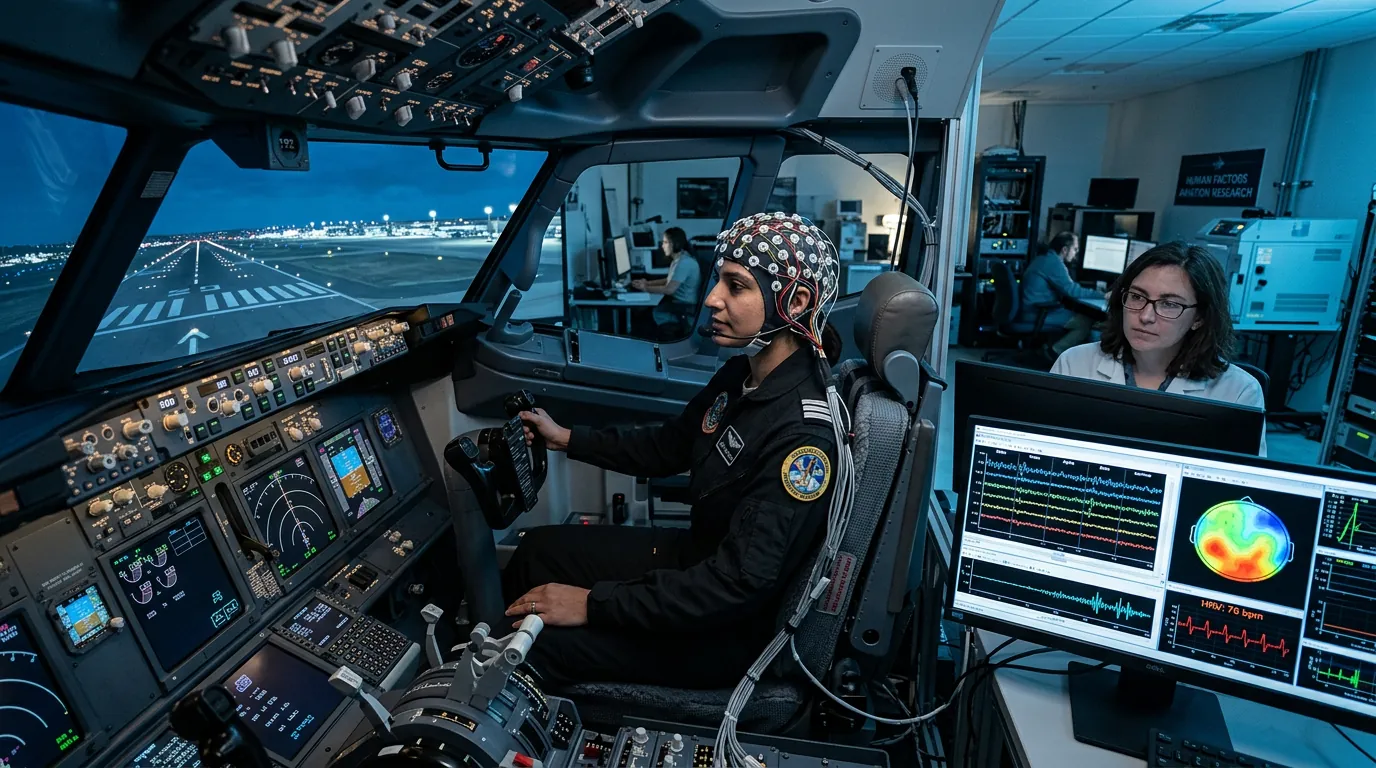
SkyDynamics is a pioneer in the application of neurophysiological signal analysis to aviation training and operational environments. Our research programme investigates how electrophysiological markers - EEG, ECG, galvanic skin response (GSR), and eye-tracking data - can objectively quantify pilot cognitive state, stress, fatigue, and skill acquisition.
EEG-Based Cognitive State Monitoring
Using portable, dry-electrode EEG systems integrated with our flight simulators, we record and analyse brain activity during training scenarios. Our algorithms extract event-related potentials (ERPs), spectral power distributions, and functional connectivity patterns to classify cognitive states such as:
- High workload - elevated theta and frontal midline theta power during complex multi-task scenarios.
- Attentional lapses - reduced P300 amplitude and increased alpha power during vigilance tasks.
- Skill automation - characteristic shifts in beta and gamma band activity as manoeuvres transition from effortful to automatic execution.
These metrics provide instructors with objective, real-time indicators of trainee cognitive engagement - complementing subjective competency assessments in CBTA/EBT programmes.
Heart Rate Variability & Stress Quantification
We analyse HRV time-domain and frequency-domain metrics to quantify autonomic nervous system balance during training and line operations. Our research demonstrates that HRV-derived stress indices correlate with:
- Scenario difficulty calibration in EBT programmes.
- Individual resilience profiles for long-haul crew scheduling.
- Real-time fatigue detection during simulator recurrent checks.
Eye-Tracking & Visual Attention
Fixation duration, saccade patterns, and dwell-time distribution on primary flight displays, navigation displays, and ECAM/EICAS messages reveal how pilots allocate visual attention. Our eye-tracking research has produced:
- Scan-pattern models for each aircraft type in our simulator fleet, serving as benchmarks for trainee assessment.
- Attention-degradation detection algorithms that flag early signs of fatigue or disengagement.
- Instrument-crosscheck scoring integrated into AeroEBT competency evaluations.
Operational Applications
The neurophysiological research pipeline at SkyDynamics is not purely academic. Every validated metric transitions into a product capability:
- AeroEBT uses cognitive-state proxies to adapt scenario difficulty in real time.
- AeroBrain RAG incorporates workload-aware response pacing - delivering information only when the crew's cognitive bandwidth allows.
- Wingman adjusts its proactive suggestion frequency based on inferred crew workload, reducing intrusion during high-demand phases.
Training Science & Pedagogy
Evidence-Based Training - From Research to Regulation
SkyDynamics' training research bridges the gap between ICAO's competency-based training and assessment (CBTA) framework and the practical needs of airline training departments. Our work spans scenario design methodology, instructor tooling, learning analytics, and the science of skill retention.
EBT Scenario Design Methodology
We have developed a structured methodology for designing evidence-based training scenarios that target specific competency indicators. Each scenario is anchored in:
- Operational data - derived from flight data monitoring (FDM), line operations safety audit (LOSA), and occurrence reports.
- Learning objectives - mapped to ICAO's 9 core competencies and their behavioural indicators.
- Difficulty scaffolding - progressive complexity calibrated by neurophysiological and performance metrics from our research.
This methodology is embedded in AeroEBT, enabling instructors to build, validate, and distribute EBT scenarios with built-in evidence trails.
Competency Assessment & Rater Reliability
Our research addresses one of the most challenging problems in CBTA: inter-rater reliability. We have developed structured rubrics and calibration tools that reduce subjectivity in competency grading. By combining instructor ratings with objective performance data and neurophysiological markers, we produce multi-dimensional competency profiles that are more reliable and actionable than traditional pass/fail assessments.
Skill Retention & Recurrent Training Optimisation
How quickly do skills decay? When should recurrent training occur? Our longitudinal studies measure skill retention curves for critical manoeuvres and procedures across different aircraft types. The data informs our MPL Programme design and helps airlines optimise recurrent training schedules - targeting competencies most at risk of decay while reducing unnecessary repetition of well-maintained skills.
Simulator Fidelity & Transfer of Training
SkyDynamics investigates the relationship between simulator fidelity level and training transfer effectiveness. Our research compares FNPT II, FTD, and FFS outcomes for specific manoeuvre types, helping regulators and operators make evidence-informed decisions about device qualification requirements - directly informing our flight simulator and FCS++ product development.
AI & Decision Intelligence Research
Responsible AI for Safety-Critical Aviation
SkyDynamics' AI research is governed by a single principle: aviation AI must be transparent, contestable, and ICAO-compliant. Our research focuses on retrieval-augmented generation (RAG), graph-based knowledge retrieval (GraphRAG), domain-specific language models, and agentic decision-support architectures.
Aviation-Tuned Language Models
We research fine-tuning strategies for large language models (LLMs) on aviation corpora - including ICAO annexes, EASA regulations, aircraft flight manuals, and airline standard operating procedures. Our fine-tuning pipeline produces models that:
- Hallucinate less on aviation-critical facts through constrained decoding and citation grounding.
- Respect authority - clearly distinguishing regulatory requirements from advisory guidance.
- Operate multilingually - supporting ICAO-standard phraseology and multiple operational languages.
RAG & GraphRAG for Aviation Knowledge
Our RAG engine - central to the AeroBrain platform - is the product of years of research into retrieval accuracy, latency, and source attribution in aviation knowledge bases. We extend traditional vector-based RAG with graph-based retrieval (GraphRAG) that captures the relational structure of aviation regulations, procedures, and aircraft systems.
Agentic Architecture & Safety Constraints
SkyDynamics researches agentic AI architectures that can plan, reason, and act within tightly constrained operational boundaries. Each AeroBrain agent operates within a governed action space:
- Read-only monitoring - observing operational data streams without taking action.
- Advisory recommendations - proposing actions with confidence scores and source citations, leaving execution authority with human operators.
- Explainability - every recommendation is accompanied by a reasoning chain that operators can inspect, question, and override.
On-Device & Air-Gapped Deployment
For defence and sovereign operations, we research compact small language models (sLMs) that run entirely on-device - enabling AI capabilities in bandwidth-constrained, air-gapped, or security-classified environments. This work underpins AeroBrain for Defence deployments.
Collaborations & Partnerships
Working Together to Advance Aviation
SkyDynamics maintains active research collaborations with universities, aviation authorities, airline training departments, and defence research agencies. We believe that the most impactful aviation research is conducted at the intersection of academia, industry, and regulation.
Academic Partnerships
Our roots in the Hellenic Mediterranean University remain a cornerstone of our research culture. Today, we collaborate with multiple European universities on joint research projects, PhD co-supervision, and funded research programmes in:
- Human factors and ergonomics in flight operations.
- Neurophysiological signal processing for training assessment.
- AI safety and explainability in safety-critical systems.
- Simulation fidelity and transfer-of-training effectiveness.
Industry Research Partnerships
We work directly with airline partners to conduct operational research using real flight data, training records, and simulator performance metrics. These partnerships ensure our research remains grounded in operational reality and transitions rapidly into product capabilities.
Defence Research
Our defence research division collaborates with NATO and national defence research agencies on secure AI, multi-domain decision support, and classified simulation environments. All defence research is conducted under appropriate security protocols and export control regulations.
Get Involved
We are always seeking new research partners. If your organisation is interested in collaborative research in aviation human factors, neurophysiological monitoring, or AI-assisted operations, contact our research team.