
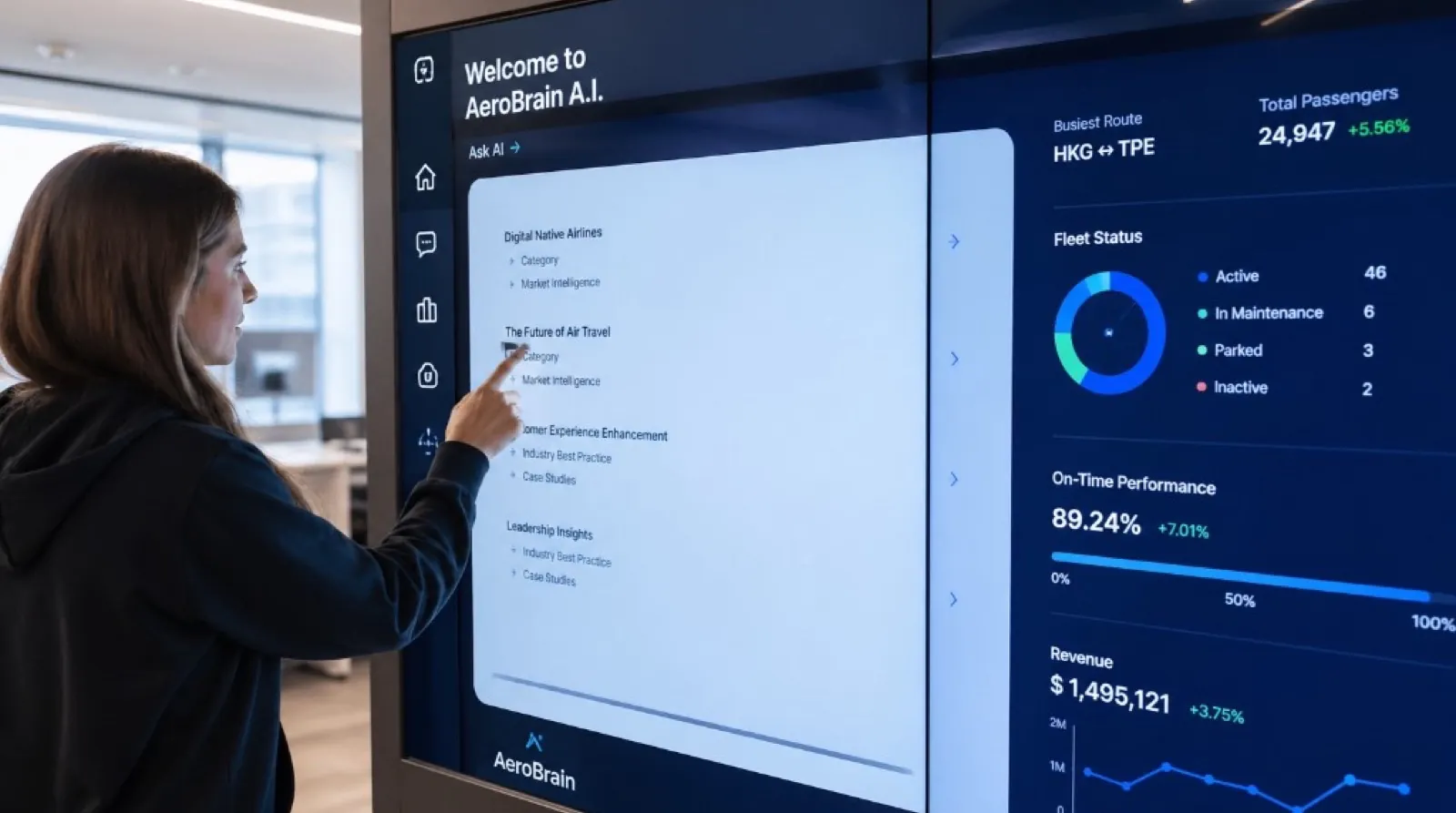
OpsEye

OpsEye · AI operations control, powered by AeroBrain
OpsEye: disruption recovery, ranked and costed. Every option checked against your rules before your controller decides.
See every flight. Predict the disruption. Resolve it by your rules. Watch it get done.
OpsEye is the operations control system built on AeroBrain. When a flight is disrupted it proposes ranked, costed recovery plans shaped by your policy and your KPIs, notifies every department in its own app and tracks each action until the recovery is complete.
Topproduct
Mostinnovative
Innovationtech
Disruptivetech
Highassurance
- Your rules
- Cost, passenger convenience and time, weighed your way
- 500+
- KPIs tuned to your company standards
- Source: SkyDynamics: what an airline can tune in OpsEye (2026-10-03)
- One app
- Controls every department app
- 3 people
- Run the operations control of a whole airline
- Source: SkyDynamics: design figure, depends on fleet and network (2026-10-03)
Disruption isn't the expensive part. The phone calls are.
A hydraulic snag becomes an AOG, the crew runs out of duty time, the slot is lost and two hundred passengers miss connections, while ops, crew control, maintenance and the customer desk piece it together over phone and chat. Every minute of that is cost you cannot see and cannot prove.
OpsEye, powered by AeroBrain
Airline disruption management. The most advanced technology for it, run by your rules.
OpsEye predicts the disruption, builds the recovery under the rules you define, tells everyone involved and tracks every action to the end. Each department works in its own app, every app reports to AeroBrain, and one control app runs the whole of it.
- A traditional operations control centre
- Phone calls, chat and a spreadsheet in every department
- With OpsEye
- One control app. Three people.
Rules you define
Cost, passenger convenience and time are weighed your way, and more than 500 KPIs are tuned to your company standards.
An app for every department
Operations, maintenance, crew control and load control each work in their own app. All of them report to one central brain.
Governed from end to end
AeroBrain is governed to EASA AI Level 1B and Level 2B. Notifications and actions follow your rules, and every one is recorded.
More than 500 KPIs and three people are SkyDynamics' figures for OpsEye. Three people is the design figure for the operations control function (operations, maintenance control, crew control and load control): what your airline needs depends on its fleet, network and approvals policy.
Department apps
An app for every department. Decentralised, and all reporting to one brain.
Operations control, maintenance, crew control and load control each work in an application built for their job. Every app tells AeroBrain, the central brain of your company, what it knows the moment it happens, and gets back what has changed for it. Nobody waits for a phone call to learn the state of the operation.
Operations control
Fleet board, network, slots and recovery
Received: Three recovery plans ready, ranked by your rules
Maintenance
MEL board, aircraft on ground and tech log
Entered here: Hydraulic fault entered: aircraft on the ground
Received: Return to service estimate requested
Crew control
Rosters, pairings, duty limits and licences
Received: Duty limits rechecked for two crews
AeroBrain
The central brain of your company
Held in one model
- Schedule
- Aircraft
- Crew legality
- MEL items
- Slots
- Weather and NOTAMs
- Passengers
- Cost
Fault received from maintenance
Operation recalculated, every app told
Load control
Load and balance for every departure
Received: Load sheet needed for the replacement aircraft
Crew app
Duty changes and briefings, acknowledged by the crew
Received: New reporting time sent for acknowledgement
Sales and passengers
Re-protection, special handling and care
Received: Eighteen connections to protect
Decentralised by design
Each department owns its app and its own work. No screen has to be shared, and no department waits for another.
Instant to the central brain
A defect, a late crew or a slot change reaches AeroBrain as it is entered, and the whole picture is updated at once.
One model of the operation
Schedule, aircraft, crew legality, MEL items, slots, weather, NOTAMs, passengers and cost are held together, so the apps never disagree.
Predictive disruption
See it coming. The disruption, hours before it happens.
OpsEye scores every flight in the next hours with a disruption index built from live weather trends, NOTAMs, crew duty time, MEL deadlines, network cascade and airport capacity, and shows which factor is driving it. The crew gets a plain-language NOTAM briefing for their route. You act while it's still cheap.
- Weather (METAR / TAF trend), NOTAMs, crew FDP, MEL deadlines, network cascade, airport capacity
- A per-flight index with the reasons behind it, not a black-box score
- Captain's NOTAM briefing generated for origin, destination and alternate
- Honest about data: if a source is down, OpsEye tells you the prediction is degraded
Disruption resolution engine
Resolve it on one screen. Every option ranked, costed and checked before you choose.
When a disruption opens, AeroBrain builds the recovery options (aircraft swap, crew from standby, delay, cancel and re-protect) and ranks them on risk, time, fuel, passenger delay, crew impact and cost. Each plan is checked against crew duty limits, curfews, the MEL, minimum connection times and maintenance capability before you see it.
Disruption resolution engine
Technical: hydraulic fault after landing at an outstation
Tier 2, active
- See disruption
- Understand cause
- Review crew
- Select plan
- Commit
- Decision gate
- 14:10Z
- Passengers at risk
- 214
- Maximum exposure
- €85k
- Ranked plans
- 4
Ranked plans
Checked before ranking: crew duty limits, curfew, MEL, minimum connection times, maintenance capability.
Sort by: Cost, Time, Passenger satisfaction
Plan ASwap to the spare aircraft
Score 70Four-eyes approval
A spare airframe with a clean tech log is on the station. Crew from the standby pool.
- Risk
- 25
- Time
- 45
- Fuel
- 15
- Passenger delay
- 35
- Crew impact
- 30
- Cost
- 50
Committed with four-eyes approval. Every department told.
Impact on each measure: a shorter bar is better.
Part of the screen is shown. Airline, aircraft and crew details are left out.
The decision gate in view
The time by which the choice has to be made, with the passengers at risk and the cost exposure beside it.
Six measures on every plan
Risk, time, fuel, passenger delay, crew impact and cost, sorted by cost, time or passenger satisfaction.
From the case to the commit
See the disruption, understand the cause, review the crew, select the plan and commit, with four-eyes approval where it is required.
Drawn from the OpsEye disruption resolution engine. Part of the screen is shown, and airline, aircraft and crew details are left out. Values are illustrative.
Your rules
You define the rules. Cost, passenger convenience and time, weighed your way.
Every airline answers a disruption differently. In OpsEye you decide what a recovery plan is judged on and how much each thing counts, and AeroBrain ranks every option by it. More than 500 KPIs can be tuned to your company standards. The limits that keep the operation legal are never traded.
The disruption
An aircraft is on the ground at an outstation with a technical fault, two hours before departure.
What matters most to your company
Ranked by the lowest total cost of the recovery.
Recovery plans, ranked by your rules
Wait for the repair
Ranked firstScore 68
The same aircraft and crew leave when the fault is cleared.
- Cost
- 90 out of 100
- Passenger convenience
- 40 out of 100
- Time
- 30 out of 100
Swap to a spare aircraft
Score 60
A spare is positioned and the flight leaves late.
- Cost
- 45 out of 100
- Passenger convenience
- 90 out of 100
- Time
- 75 out of 100
Cancel and re-protect
Score 59
Passengers move to other flights and the rotation is rebuilt.
- Cost
- 55 out of 100
- Passenger convenience
- 35 out of 100
- Time
- 95 out of 100
500+
KPIs tuned to your company standards
Among them
- Cost of a delay minute
- By station and time of day
- Minimum connection time
- By hub and passenger type
- Duty margin kept in reserve
- By fleet and crew base
- On-time performance target
- By route
- Finance approval threshold
- By size of the decision
Never traded
- Crew duty limits
- Minimum equipment list
- Airport curfews
- Minimum connection times
A plan that breaks one of these is not shown.
Three priorities, your balance
Cost, passenger convenience and time are weighed as your company decides, for the whole network or for a single case, with your own cost values, thresholds and targets behind them.
Hard limits stay hard
Crew duty limits, the MEL, curfews and minimum connection times are checked before a plan is shown.
Overrides on record
A duty manager can overrule a company policy with a second approver, and the reason is kept. Regulatory limits are not company policy: they stay.
More than 500 KPIs is SkyDynamics' figure for what an airline can tune in OpsEye. The disruption, the plans and their scores in the figure are illustrative.
Governed AI
AeroBrain is governed. To EASA AI Level 1B and Level 2B, with every step on record.
AeroBrain is the central brain behind every app, so it is governed at each step. At Level 1B it assists: it proposes ranked plans with their reasons, and a person decides. At Level 2B it works with your team: it carries out the actions your rules hand to it, inside limits you set, and a person can take any of them back.
First, the hard rules
Every option is checked against the limits your company and the regulations set. An option that breaks one is never shown.
- Crew duty limits
- Minimum equipment list
- Curfews and slots
Level 1B Human cognitive assistance
AeroBrain assists the decision. A person makes it.
AeroBrain proposes
Ranked, costed plans, each with the reasons and the data behind it.
A person decides
The controller chooses the plan. A regulated action needs a second approver.
Level 2B Human and AI collaboration
AeroBrain works with your team, inside limits you set.
AeroBrain carries out its part
The actions your rules hand to it, such as notifications and slot messages.
A person can take over
Any action handed to AeroBrain can be stopped or taken back at any moment.
Every step on record
Who proposed, who approved, who acted and on which data.
The record of this decision
- Two options removed, the reason kept
- Three plans proposed, each with its reasoning
- Plan chosen, approved by two people
- Six notifications and one slot message sent
- One action taken back by the duty manager
Levels as described in the EASA Artificial Intelligence Concept Paper, Issue 2.
A person holds the decision
AeroBrain proposes and explains. The controller chooses, and regulated actions need a second approver before they are committed.
Limits you set
What AeroBrain may carry out on its own, such as notifications and slot messages, is written in your rules and can be taken back at any moment.
A complete record
Who proposed, who approved, who acted and on which data, kept for every case.
Level 1B (human cognitive assistance) and Level 2B (human and AI collaboration) are the levels described in the EASA Artificial Intelligence Concept Paper, Issue 2. This is SkyDynamics' own classification of AeroBrain against that guidance: EASA has not certified or approved the system.
Notification governance
Everyone involved is told. The right people, in the right order, by rule.
When a plan is committed, OpsEye does not broadcast. Your rules decide who is told, what each person is told, how long they have to acknowledge and who is told next if they do not. Each message arrives in that person's own app, with the action that belongs to them.
The event
An aircraft swap at an outstation is ready to commit.
- Priority
- Critical
- Cost exposure
- Above the finance threshold
Your rule
- Tell first
- Finance, before the plan is committed
- Then tell
- Maintenance, crew control, load control, the station and passenger services
- Acknowledge within
- Ten minutes
- If nobody answers
- Tell the duty manager
Who is told, and what
Finance
Exposure above the threshold: approval needed
Acknowledged
Maintenance
Release the replacement aircraft
Acknowledged
Crew control
Confirm the crew and their duty limits
Acknowledged
Load control
Issue the load sheet for the replacement aircraft
Acknowledged after the duty manager stepped in
Station
Change of aircraft and stand
Acknowledged
Passenger services
Eighteen connections to protect
Acknowledged
Six notifications, six acknowledgements and one escalation, kept with the case.
Who is told
Recipients come from your rules: by event, station, fleet and the size of the exposure.
What they are told
Each person gets their own action, owner and deadline, not a copy of everything.
Acknowledged or escalated
A message nobody answers goes to the next authority when its time runs out, and every step is kept with the case.
Execution tracking
Every action is tracked. From commit to done, with nothing left to chase.
A plan is only as good as its execution. Every action in the recovery has an owner, a deadline and a status, and the plan updates itself as people acknowledge and complete their part. The control team sees what is done, what is late and what is blocking the recovery, without a single status call. That is the assurance, and it is where the time is saved.
Plan health
100%
Share of the actions that are done
Recovery complete. The timeline is kept for the debrief.
Slots and ATC
Confirm the new departure slot
Owner: Network desk
Done
Crew control
Call the standby crew and confirm duty limits
Owner: Crew controller
Done
Maintenance
Release the replacement aircraft
Owner: Maintenance control
Done
Passenger services
Protect eighteen connections
Owner: Customer desk
Done
Load control
Issue the load sheet for the replacement aircraft
Owner: Load controller
Done
The load sheet ran past its deadline and was flagged at once: the departure waited on it, so the duty manager was told.
Owner, deadline, status
Each action is pending, acknowledged, in progress, done or failed, and it shows.
Late actions surface themselves
An action past its deadline is flagged at once, with what is waiting on it.
Plan health, live
One figure for how much of the recovery is complete. The full timeline stays with the case for audit, review and training.
One control app
One app. Three people. Enough to run the operations control of a whole airline.
The department apps are separate; the control is not. One control app sees every department, every open case and every action, and AeroBrain handles the routine under your rules. What reaches your control team is the exception that needs a person. That is how three people can run operations, maintenance control, crew control and load control for a whole airline.
1control app
Every department, case and action in one place
3people
Running the operations control of a whole airline
Operations controlA slot moves by ten minutes
Handled by rule: Departure time updated, crew and station told
MaintenanceA defect is deferred inside MEL limits
Handled by rule: Restriction recorded, later flights rechecked
Crew controlA crew member reports sick, standby available
Handled by rule: Standby assigned, duty limits checked
MaintenanceAn aircraft is grounded at an outstation
To the control team: Choose the recovery plan
Load controlLate baggage, weight inside limits
Handled by rule: Load sheet updated and sent to the crew
Sales and passengersTwelve passengers will miss a connection
Handled by rule: Rebooked on the next flight, care arranged
Crew controlA recovery would exceed a duty limit
To the control team: Decide, with a second approver
Operations controlWeather closes an alternate airport
Handled by rule: New alternate set, crew briefed
6handled by rule
2sent to the team
What is handled by rule is set by your company. The split shown is an example.
Everything in one place
Operations, maintenance, crew control and load control, each in its own app, all controlled from one.
Routine by rule
What your rules already answer is handled and recorded without taking a person's time.
Exceptions to people
The team is asked only where judgement, authority or a second approver is needed.
Three people is SkyDynamics' design figure for the operations control function. What your airline needs depends on its fleet, network and approvals policy.
Inside the OCC
Complex underneath. Simple to operate.
The system does the heavy lifting; controllers see a clean board, a clear priority and the next action. Eight of the views your operations control centre works in every day.
Fleet board
Every aircraft on one board: status, origin and destination delay trends, the disruption index at each station and any open irregularity: AOG rows impossible to miss.
Step 1 of 8
Live network
ADS-B and ACARS positions on the map, a flight tracker beside it, and each station's disruption index so you see where the network is under strain.
Step 2 of 8
ATFM & slots
Active regulations, a CTOT countdown for every affected flight and ready messages (REA) sent automatically where your rules allow, with a predictive alert before the flow restriction lands.
Step 3 of 8
Crew & maintenance
Crew rosters with FTL headroom and licence status next to the MEL board (CAT A to D, deferrals and AOG) so a recovery plan never assigns an illegal crew or an unfit aircraft.
Step 4 of 8
Passenger recovery
Unaccompanied minors, medical cases and reduced-mobility passengers handled first, SLA tiers for everyone else, and EC261 care and compensation handled inside the recovery flow.
Step 5 of 8
Recovery plans
When a disruption opens, AeroBrain builds the options (aircraft swap, crew from standby, delay, cancel and re-protect) and ranks them on risk, time, fuel, crew impact, passenger delay and cost. Each plan is checked against crew FTL, curfews, MEL, minimum connection times and maintenance capability before you see it.
Step 6 of 8
Priority queue
Every irregularity lands in one queue (safety first, then legality, hub integrity and cost), ordered by the escalation rules and owners your airline defines, with cost gates that route large decisions to the right authority.
Step 7 of 8
Execution monitor
Workstreams per department with their actions, owners and deadlines, and one plan health figure, so the control team sees what is done, what is late and what is blocking the recovery.
Step 8 of 8
Cost, per decision
Every decision, costed. Against a baseline agreed with your finance team.
Real-time optimisation of fuel, time, aircraft, crew and Cost Index, inside FTL, EU 261, ETS and CORSIA guardrails. Every decision is costed against a baseline agreed with your finance team and kept in an audit-locked ledger, so your CFO sees the saving per decision and the method behind it.
- Fuel: tankering, centre of gravity, CO₂
- Time & asset: aircraft, crew and slot cost modelling
- Cost Index governance with FTL / EU 261 / ETS / CORSIA guardrails
- Counterfactual ROI: baseline minus actual, audit-locked
Built for digital-native airlines
Enterprise depth without enterprise drag
OpsEye is built to go live fast and stay light to run, for airlines that want their operation to be as digital as their booking flow.
Manuals in one query
MEL, AMM, QRH, FCOM and Ops Manual searched together by AeroBrain.
Specialised agents
OCC, crew, maintenance, finance, safety, dispatch and passenger recovery.
Offline by default
Keeps running on the workstation during an outage; syncs on reconnect.
Connects to what you run
ACARS, AODB, ADS-B, EUROCONTROL NM B2B and your crew and maintenance systems.
Why OpsEye
Versus a traditional OCC
React after the cascade
predict it hours ahead, with the reasons.
Recovery built by hand
ranked, costed, legal plans in seconds.
Vendor-default logic
your rules on cost, passenger convenience and time, your overrides on record.
Phone and chat coordination
every department told in its own app, by rule.
Status by calling around
execution tracked live, action by action.
A desk for every function
one control app and a team of three.
Unprovable savings
each decision costed against a baseline agreed with your finance team.
OpsEye: questions buyers ask
What is airline disruption management software?
Airline disruption management software helps an operations control centre deal with irregular operations: it predicts where the schedule is at risk, builds recovery plans for aircraft, crew and passengers, and coordinates the departments that carry them out. OpsEye, from SkyDynamics, does this on the AeroBrain AI: you define the rules, each department works in its own app, and one control app tracks the recovery to the end.
What is OpsEye?
OpsEye is SkyDynamics' airline disruption management and operations control system. Built on the AeroBrain AI, it monitors the fleet and network in real time, predicts disruptions, proposes ranked and costed recovery plans according to your company rules and KPIs, notifies every department in its own app and tracks the recovery until it is complete.
Is OpsEye a decision support system for airline operations?
Yes. OpsEye is AI decision support for the operations control centre. It predicts disruption per flight and shows the contributing factors, then proposes ranked and costed recovery plans weighted by your company policy and KPIs. A person decides, regulated actions require four-eyes approval, and every decision is logged.
Can we define our own rules?
Yes. You decide what a recovery plan is judged on (cost, passenger convenience and time) and how much each counts, for the whole network or for a single case. More than 500 KPIs can be tuned to your company standards, alongside your escalation rules, owners and cost gates. Limits such as crew duty time, the MEL and curfews are checked before a plan is shown. A duty manager can overrule a company policy when needed: OpsEye requires a second approver and logs the decision.
Which departments have their own app?
Operations control, maintenance, crew control and load control each have a dedicated app, as do the crew, sales and passenger services, and the integrated control centre. The apps are decentralised: each department works in its own, and every app reports to AeroBrain the moment something changes and receives what has changed for it. One control app sees and controls all of them.
What role does AeroBrain play?
AeroBrain is the central brain of the company: the AI that holds fleet, crew, maintenance, slots, weather, NOTAMs, passengers and cost in one model. Every department app reports to it, and OpsEye is how the operations control centre works with it. The same AeroBrain engine runs across SkyDynamics operations, training and defence products.
How is the AI governed?
AeroBrain is governed at each step. SkyDynamics classifies it against the EASA Artificial Intelligence Concept Paper, Issue 2, at Level 1B (human cognitive assistance: it proposes ranked plans with their reasons and a person decides) and Level 2B (human and AI collaboration: it carries out the actions your rules hand to it, inside limits you set, and a person can take any of them back). Hard rules are checked before a plan is shown, regulated actions need four-eyes approval, and every proposal, approval and action is recorded. This is SkyDynamics' own classification: EASA has not certified or approved the system.
What happens after a plan is committed?
Your rules decide who is told, what each person is told, how long they have to acknowledge and who is told next if they do not. Each person receives their own action in their own app. Every action then has an owner, a deadline and a status: late actions are flagged at once, and plan health shows how much of the recovery is done. The whole exchange is kept with the case for audit, debrief and training.
How many people does it take to run?
OpsEye is designed so that three people can run the operations control of a whole airline: operations, maintenance control, crew control and load control. The departments work in their own apps, one control app sees all of them, and AeroBrain handles the routine under your rules, so the team deals with the exceptions that need a person. Three is SkyDynamics' design figure: what your airline needs depends on its fleet, network and approvals policy.
How fast does OpsEye respond to a disruption?
Ranked recovery options are available within seconds of a case opening, covering aircraft, crew, gates and passenger re-protection. A person decides; regulated actions require four-eyes approval.
What does OpsEye predict?
A disruption index per flight from weather trends (METAR / TAF), NOTAMs, crew flight-duty time, MEL deadlines, network cascade and airport capacity, with the contributing factors shown. It also produces a NOTAM briefing for the crew.
When do savings show?
As soon as decisions are taken in OpsEye. Each one is costed against a baseline agreed with your finance team and kept in an audit-locked ledger. The baseline is an estimate of what would have happened without OpsEye, so its method is agreed with you before the first figure is reported.
Does it work during a network outage?
Yes. OpsEye keeps working on the workstation with local storage and syncs when the connection returns.
Which regulations does it respect?
EASA ORO.FTL.205, EU 261, EU ETS, CORSIA, ICAO Doc 4444 and Part-145, with four-eyes approval on regulated actions.
One ecosystem. One central brain.
OpsEye is one node on a connected platform.
See OpsEye resolve a live disruption
Bring a real disruption from your operation. We'll show you the prediction, the ranked plans under your rules, and the execution, end to end.
We respond within one business day.